Plank Hip Dip
What are plank hip dips, and how do they add rotation to your plank workout?
The Plank Hip Dip is a beginner-level isometric movement that primarily targets the obliques, transverse abdominis. It uses bodyweight as the primary implement and engages the glutes, shoulders as secondary movers. In this guide you'll find a complete breakdown — anatomy, step-by-step setup, execution, coaching cues, common mistakes, programming recommendations, regressions, progressions, warm-up, cool-down, safety notes, and FAQs.
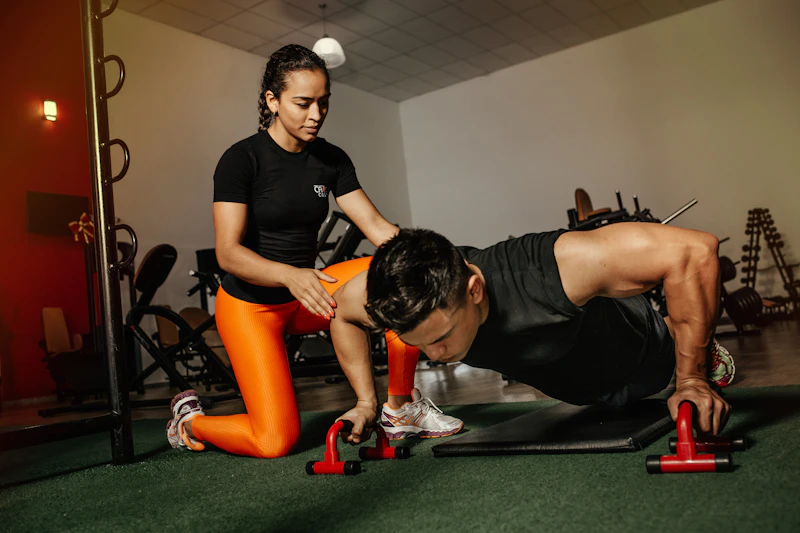
How to perform
-
1
Set up your bodyweight with a weight that allows clean form for 10–12 reps.
-
2
Position your body so the obliques, transverse abdominis is the primary mover — brace your core before each rep.
-
3
Stack your joints — wrists under elbows, elbows under shoulders, feet hip-width for stability.
-
4
Establish a neutral spine, draw your ribs down, and breathe in to brace.
-
5
Initiate the movement with intent — control the eccentric, explode on the concentric.
Execution
-
1
Inhale and brace your core — 360° pressure into the belt line.
-
2
Lower under control (3-1-1-1 tempo) — keep tension on the target muscle.
-
3
Pause for a beat at the bottom of the range without losing brace.
-
4
Drive through the target muscle group, exhaling on the concentric.
-
5
Lock out cleanly without hyperextending — reset and brace for the next rep.
- ▸ Brace 360° around your core before every rep — never lift on a soft midsection.
- ▸ Drive through the obliques, transverse abdominis as the primary mover, not the joints.
- ▸ Control the eccentric for 2–3 seconds — this is where most core & abs growth happens.
- ▸ Train the longest range you can control safely — partial reps build partial strength.
- ▸ Leave 2 reps in reserve on most working sets — autoregulate when life hits hard.
- ✕ Loading the bar too heavy before owning the technique at submaximal weights.
- ✕ Cutting the range of motion short to move more weight than you can actually control.
- ✕ Letting momentum take over — bouncing, jerking, or losing brace at the bottom.
- ✕ Skipping the warm-up sets and jumping straight to working weight.
Periodisation note: Run this exercise for 4–6 weeks, then change the variation or progression. Add load when the top set feels RPE 6 — never chase numbers at the cost of form.
- Reduce load by 20–30% and slow the tempo to 4-1-2-1.
- Switch to a more stable variation: machine or supported version of the plank hip dip.
- Reduce range of motion to the pain-free portion and gradually re-expand over weeks.
- Add 2.5–5% load weekly while keeping RPE 7 on the top set.
- Increase range of motion with deficit or pause variations once you own the standard plank hip dip.
- Add a tempo or pause at the hardest position to increase time under tension.
- Tempo plank hip dip (4-2-1-0)
- Paused plank hip dip at the sticking point
- Deficit plank hip dip (increased range)
- Banded plank hip dip (accommodating resistance)
- 5 min easy aerobic work to raise tissue temperature.
- Dynamic mobility for dead bug breathing, cat-cow, pelvic tilts.
- 2 specific warm-up sets of the plank hip dip at 50% and 75% of working weight.
- 5 min easy aerobic cool-down.
- Static stretching: cobra pose, supine twist, child's pose.
- Breath work — 4–7–8 breathing for 5 rounds to downregulate.
- Get cleared by a physio if you have lumbar disc pathology, diastasis recti, recent abdominal surgery.
- Always use a spotter or safety pins for barbell work near 1RM loads.
- Check equipment integrity — bar collars, bench stability, clips on bands.
- Stop if you feel sharp pain in a joint. Muscle burn is fine; joint pain is not.
- Primary developer of the obliques, transverse abdominis.
- Reinforces the isometric pattern used in daily life and sport.
- Builds strength and stability in the core & abs musculature.
- Improves movement competency under load.
- Foundational movement for almost every structured training program.
- Anyone with acute lumbar disc pathology, diastasis recti, recent abdominal surgery.
- Beginners who haven't earned the right to load the pattern yet.
- Anyone returning to training after surgery without physio clearance.
- Barbell — highest load potential, requires good mobility and stability.
- Dumbbells — greater range, less stable, good for asymmetry correction.
- Bands or machine — lower joint stress, great for rehab or burnout sets.
Research on isometric movements consistently shows the obliques, transverse abdominis as the primary mover, with meaningful activation of the glutes, shoulders. Time under tension in the 10–12 rep range with 60–90s rest is the sweet spot for both strength and hypertrophy adaptations.
Frequently asked questions
How often should I do the plank hip dip?
2–3x/week is a good starting point. Advanced lifters can hit core & abs 2x/week with at least 48h recovery between sessions.
Is the plank hip dip good for beginners?
Yes, if the load is conservative and technique is coached. Start with the regression listed above and progress from there.
What weight should I use for the plank hip dip?
Pick a weight that lets you complete the target reps with RPE 7–8 — that means 10–12 reps with 1–2 left in the tank. Add 2.5% when it feels easy.
Can I do the plank hip dip at home?
Yes, if you have the equipment. If not, see the equipment alternatives below for bodyweight or band-based substitutes that hit the same muscles.